Good morning. We're back to the regular cadence, so there aren't a hundred links to scroll through this time, just 23. It still amazes me how much news there is in chemicals, but it's a big world, and there are a lot of chemicals.
| WTI Crude | $96.16/bbl | -0.3% |
| Brent Crude | $113.96/bbl | -0.8% |
| HH Nat Gas | $3.18/MMBtu | +9.7% |
| MB Propane | $0.89/gal | +3.5% |
| 3:2:1 Crack | $64.10/bbl | -8.7% |
BASF wants Evonik
BASF offered about $11.7 billion ($25 a share) for Evonik, another of Germany's big chemical companies, and Evonik turned it down as too low.
Wait, who owns Evonik?
Evonik is about the most piecemeal chemical company you could imagine: gold refiners, utilities and old chemical companies stitched together in ways I can't untangle in a paragraph. What matters is that about 44% of it belongs to the RAG-Stiftung, a foundation that pays, forever, to pump water out of Germany's closed coal mines. That cost it $350 million last year, and Evonik's dividend covered $290 million of it.
So, what would it take?
Selling to BASF would cut off the foundation's biggest source of cash, so the price has to be high enough for it to buy something else that pays the same. At BASF's offer its stake is worth about $5.1 billion, which would have to earn more than 5% a year to replace that dividend. The foundation says it could sell the whole stake, but its board includes two state premiers, two federal ministers and the head of the chemical workers' union, who has already said that being bigger doesn't save jobs or sites on its own. I'm not expecting a quick yes.
Toray wants its PPS back
Japanese chemical company, Toray, has developed a way to recover polyphenylene sulfide (PPS) from waste with a solvent, and plans to sell the recycled resin around 2030.
Why PPS?
Carmakers have a ladder of engineering plastics to choose from. Nylon (PA66) is the cheap workhorse but starts to struggle above about 120–130°C, PPA goes a bit further, and PEEK goes furthest at the highest price. PPS sits near the top, below PEEK: it holds its shape in hot coolant and fuel and is flame retardant on its own, which is why it shows up in EV coolant manifolds, battery cooling and transmission parts. Toray makes about 30 KTA of it in Japan and Korea, alongside DIC, Syensqo and Fortron (Celanese and Kureha's joint venture).
Why now?
Europe's end-of-life vehicle rules took effect in August: new car models need 15% recycled plastic from 2032 and 25% from 2036, with a fifth of that from scrapped cars. The other engineering plastics are already lining up recycled grades. BASF, pointing to those rules, made pilot parts for Mercedes-Benz from nylon recovered from old cars, and Toray itself is testing nylon recycling on intake manifolds from scrapped Hondas. Without a recycled grade of its own, PPS could start losing some of its market share. This route adds to the mechanical one Toray announced in 2023, and both depend on collection.
More aluminum nitride for chipmaking
Japanese chemical company Tokuyama is building a new aluminum nitride powder line in Yanai, Japan, adding about 30% to its capacity by April 2028.
Wait, what's aluminum nitride?
If it sounds familiar, we covered Ube's silicon nitride expansion in 2023. Aluminum nitride pairs one aluminum with each nitrogen (AlN, versus Si₃N₄), and the result is a ceramic that moves heat much better but is less strong. It goes into the parts that hold and heat wafers in chipmaking tools, power-electronics substrates and heat-dissipating fillers, mostly competing with cheaper alumina. Tokuyama cites AI chip demand; maybe hotter, newer chips need the better heat handling, but I don't really know.
Market size, for perspective:
We talk a lot about 1,000 KTA ethylene crackers here. Aluminum nitride, despite showing up all over chipmaking, is a drop in the bucket. Tokuyama stopped publishing tonnage after its last expansion took it from 0.6 to 0.8 KTA in 2020, so another 30% puts it around 1 KTA. It claimed about 75% of the world market in 2019, and Chinese producers have added hundreds of tons a year since, so the whole world probably makes something like 2–5 KTA.
The Reboiler:
- Air Liquide is investing $195M to build ultra-pure gas units for semiconductor customers in Japan.
- Kemira just closed this deal we talked about last February, buying German coagulants producer Sidra Wasserchemie.
- Lynas Rare Earths agreed to acquire Meteoric Resources for $680M.
- The European Commission cleared Aequita's acquisition of Sabic Europe.
- NextChem secured a technology contract for a 1,040 KTA urea plant in China.
- Jinan Acetate Chemical agreed to buy Cerdia Holding for about $368M.
- AkzoNobel sold its Pakistan coatings business to IGI Investments for ~$57M.
- Sabic Agri-Nutrients licensed KBR's ammonia purification technology for a urea capacity expansion in Jubail, Saudi Arabia.
- Borouge started up a specialty PP compounding line in Schwechat, Austria.
- Technip Energies awarded a license and FEED contract for a mixed-feed ethylene complex in Aliağa, Türkiye.
- Ancora raised its acquisition offer for H.B. Fuller's building adhesives segment to $1.4B.
- Idemitsu produced naphtha from plastic-derived oil at its Chiba refinery.
- LG Chem and Volkswagen signed a collaboration agreement on sustainable ABS and engineering plastics for automotive applications.
- Brenntag is partnering with DSM-Firmenich to exclusively distribute its biopharma-grade vitamin portfolio.
- Thyssenkrupp secured a chlor-alkali plant order from Hongniu Lanzhou in China.
- Tecnimont USA signed a FEED contract with Argent LNG for an export facility at Port Fourchon, Louisiana.
- Avantium made its first commercial-scale FDCA at its Delfzijl plant, which we talked about last week.
- India's SECI invited bids for a 10-year, 54 KTA green ammonia supply contract.
- Toyo Engineering completed a 760 KTA ammonia and 1,320 KTA urea line for Indorama in Rivers State, Nigeria.
- Statkraft sold its UK green hydrogen portfolio to Kentron and Foresight.
- Hyundai E&C joined a South Korean government R&D project to develop 100-MW water electrolysis plants.
- Indorama secured a $358M loan to double urea fertilizer capacity in Anyang, China.
- Arkema inaugurated an $11M hydrogen production unit at its Jarrie site in France.
MOTD: acrylic acid
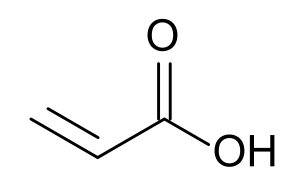
Acrylic acid owes its name to the smell of burnt fat: glycerol in the fat breaks down into acrolein, which smells acrid. It's made by oxidizing propylene to acrolein, then oxidizing that acrolein to the acid.
The world uses about 7 million tons of acrylic acid a year, with capacity nearing 10 million tons as new plants come online in China, India and Indonesia. Most of it becomes acrylate esters like butyl acrylate, which end up in coatings, adhesives, sealants and elastomers. Most of the rest becomes superabsorbent polymer, mainly for diapers.
The biggest producers are BASF, Arkema and Nippon Shokubai, with Dow, LG Chem and fast-growing Chinese producers like Satellite Chemical close behind.