Good morning. Today: Goodyear finishes getting out of chemicals, more POE capacity is being built in China than anyone needs, and Daikin plans to destroy PFAS right where it makes them. Hope everyone has a great weekend!
| WTI Crude | $96.24/bbl | +0.1% |
| Brent Crude | $125.44/bbl | +10.1% |
| HH Nat Gas | $3.03/MMBtu | -4.7% |
| MB Propane | $0.92/gal | +3.1% |
| 3:2:1 Crack | $61.89/bbl | -3.4% |
Goodyear is done with chemicals
Goodyear is closing its last two chemical plants, in Bayport, Texas and Niagara Falls, New York, cutting about 85 jobs. Niagara Falls reportedly shuts at the end of this month, and Goodyear expects the whole plan to be finished by the end of 2027.
Catching you up:
When we last wrote about Goodyear's chemical business, Goodyear was the last of the old tire makers still making its own synthetic rubber, and it wanted out. Last October it sold that business to Gemspring Capital for $650 million but kept these two plants, which work as a pair: Bayport mainly makes hydroquinone, and Niagara Falls reacts it with a mix of aromatic amines (including ortho-toluidine) to make a mix of diaryl-p-phenylenediamines that keep tires and belts from cracking.
So why the closure?
Goodyear's own numbers tell the story: shutting the plants costs about $30 million in cash and adds $15–20 million a year to operating income, so they're losing money, and the closure pays for itself in under two years. That's likely why Gemspring passed. Niagara Falls also comes with baggage. Ortho-toluidine is a bladder carcinogen, New York cut its air limit for it a thousandfold in 2021, and the state ordered permanent pollution controls by the end of this month, right when the plant reportedly shuts.
China's homegrown POE gets bigger
Swiss equipment maker Sulzer signed off on the purification unit at Shandong-based BeyondPoly's new 100 KTA polyolefin elastomer (POE) plant. That's BeyondPoly's second plant, more than three times the size of the 30 KTA one it started up in December 2023.
What's going on here?
POE is ethylene copolymerized with an alpha-olefin, usually 1-octene or 1-butene, in a solvent, and Sulzer's DEVO unit boils the leftover solvent and monomer out of the polymer. China is the biggest buyer, and in 2024 it still imported over 90% of what it used, mostly from the US, South Korea, and Japan. More than 40% of those imports were solar grade.
Bigger picture:
A handful of companies, led by Dow, make most of the world's POE, but Chinese producers are catching up fast. Wanhua started a 200 KTA plant in mid-2024, and Lianhong and Sinopec have 100 KTA plants starting up or being built this year. If everything planned gets built, China will have about 2,500 KTA of capacity by 2027 against about 1,800 KTA of demand, so I'd expect prices to fall.
Destroying PFAS where it's made
Claros Technologies and Daikin America signed a deal to build a full-scale PFAS destruction unit into Daikin's fluoropolymer plant in Decatur, Alabama.
A little background:
Daikin says its wastewater treatment has cut long-chain PFAS by 99.9% since 2012. Claros breaks the C–F bonds with UV light and proprietary reagents, leaving free fluoride, and in two trials at Decatur, a 50,000-gallon pilot and a 170,000-gallon run, it destroyed over 99.99%, as measured by its own lab. That's another order of magnitude achieved by destroying short- and ultra-short-chains, including TFA.
So, what's next?
The companies were vague: no size, cost or start date, just "over the next few years" and a promise to look at Daikin's other plants. And Daikin is a Claros investor (it joined the $55 million Series B in July), so this reads less like a customer win and more like the next step in Claros's own development.
The Reboiler:
- Arkema opened a ~$175M, 25% more energy-efficient acrylic acid purification unit in Carling, France.
- Air Products will build and run a ~200 KTA LNG-cooled air separation unit for a Petronas Gas-led terminal in Pengerang, Malaysia.
- Aclara and CAP opened a Chilean demo plant turning NdPr oxides into rare earth metals.
- Calgon Carbon nearly doubled reactivated carbon capacity in Crosby, Texas.
- Rashtriya Chemicals and Fertilizers hired L&T for a $90M energy-saving revamp of its Thal ammonia plant.
- Posco Future M will supply Samsung SDI with $4.4B of LFP cathode materials from 2027 to 2032.
- LG Energy Solution will buy 240 KT of spodumene over four years from Elevra's Quebec mine.
- Evonik developed biodegradable polymers for its next Eudragit oral drug excipients.
- POSCO finished its second Argentine lithium plant, a $954M, 23 KTA carbonate unit at Hombre Muerto.
- Borouge International is adding 14 KTA of mechanical recycling in Germany and Austria.
- ENEOS opened a 3 KTA Queensland plant making methylcyclohexane directly via electrolysis, a bigger version of the 2023 demo.
- Nutrien indefinitely shut its Trinidad nitrogen complex over natural gas shortages.
- Heraeus Precious Metals added its Visakhapatnam, India, site to its global catalyst production network.
- Thyssenkrupp Nucera is building a $12–16M electrolyzer cell assembly hub near Porto, Portugal, opening in 2028.
- Sherwin-Williams opened its expanded Statesville, North Carolina, plant, now its largest in North America.
- Sumitomo Chemical scaled up a liquid crystal polymer made from ~30% biomass feedstock and will start sampling it.
- Shanshan plans a $760M, 150 KTA battery anode plant in Baotou, Inner Mongolia.
- Voestalpine and Verbund are adding $19M of compression and storage to their H2FUTURE green hydrogen pilot in Linz, Austria.
- Nouryon switched on solar covering ~10% of its Morris, Illinois, plant's power, three years after the deal.
- Saint-Gobain bought Xypex, a Vancouver maker of concrete waterproofing with ~$80M in sales.
- Hindalco called off its $125M purchase of US high-purity alumina maker AluChem, which we covered last July.
- Rain Carbon and BioBTX are teaming up to turn oil from BioBTX's planned 10 KTA Dutch plastic-waste plant into benzene and phthalic anhydride.
- Nippon Paint is buying AkzoNobel's Southeast Asian and Australian house paints business for $1.35B.
- SK Pharmteco is investing $200M+ over five years in US small-molecule API and peptide capacity.
- Avantium spun off its plant-based polyesters business as Parana Materials to focus on the FDCA plant we covered two weeks ago.
- Henkel closed its ~$2.5B purchase of Stahl, a Dutch maker of coatings for leather and other flexible materials.
- Novonesis bought the rest of Australian yeast biotech MicroBioGen, after holding 23% since 2013.
- Hexpol bought Italian cable compounder Vipa Group for $170M.
- The Rhine hit a record low at Kaub, letting only a few light barges through and cutting BASF's Ludwigshafen off from Rotterdam.
- Axens will design a unit upgrading tire pyrolysis oil into low-sulfur fuel for an unnamed US developer.
- Elkem approved a $25M furnace replacement at its Rana ferrosilicon plant in Norway.
- Plug Power will supply 280 MW of electrolyzers for Arcadia eFuels' e-SAF plant in Vordingborg, Denmark.
- Rio Tinto and Shougang started up a 10 KTA carbon capture trial on a Chinese blast furnace.
- Corteva spun off its seed business as Vylor to focus on crop protection.
- Mutares bought Synthomer's Czech acrylic acid and acrylates business.
- Westlake is closing its 165 KTA Cologne PVC plant early next year, taking ~$205M in charges.
- Chemplast Sanmar restarted its Karaikal, India, EDC plant after regulators provisionally lifted a post-fire shutdown order.
- Tessenderlo bought a 20% stake in FMC for $403M and nominated its CEO to FMC's board.
- Hodogaya Chemical closed its ~$100M purchase of Hungarian phosgene-derivatives maker Framochem.
- Jacobs extended its management role on thyssenkrupp Steel's 2,500 KTA hydrogen-ready direct reduction plant in Duisburg, Germany.
- Hexcel started US production of its fast-curing HexPly M901 prepreg in Salt Lake City.
MOTD: propylene oxide
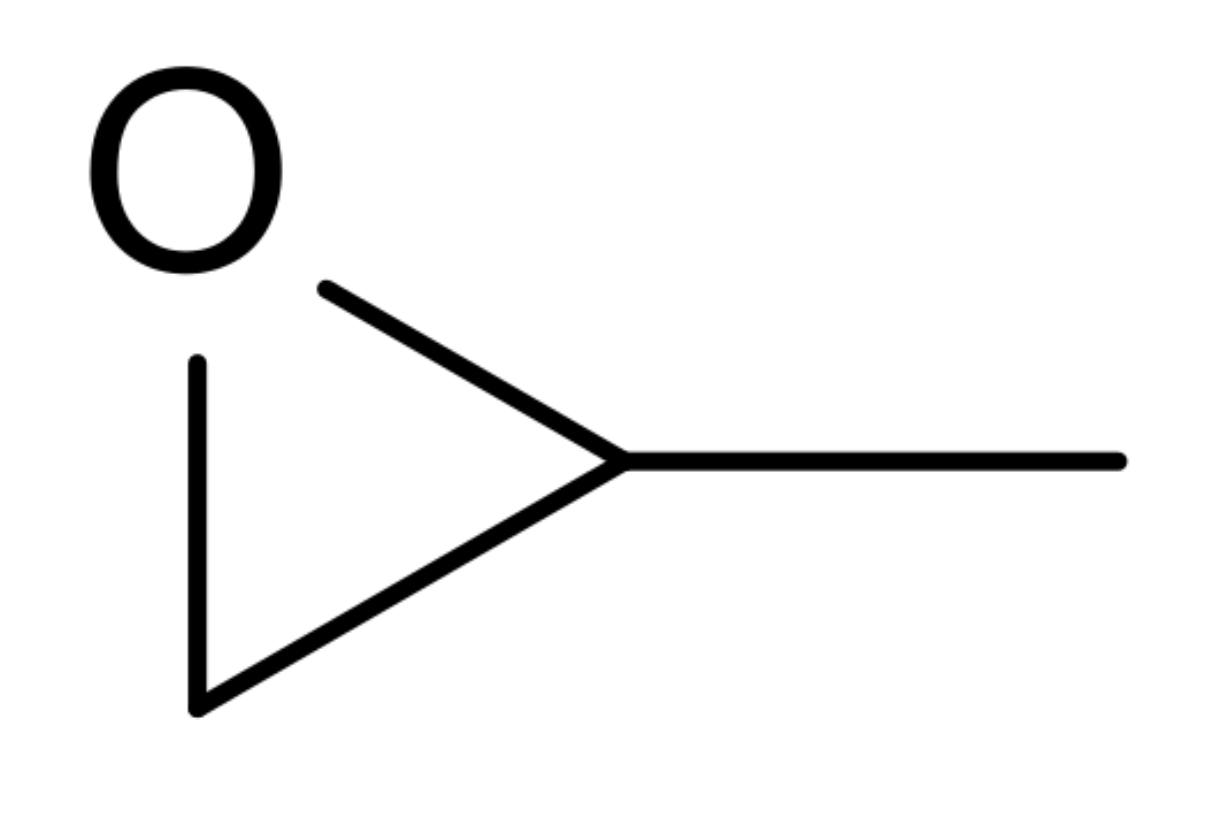
First produced by Oser in 1861, propylene oxide (PO) was the first chiral molecule detected in space and is occasionally used to pasteurize raw almonds.
Today, China alone can make about 9,300 KTA of PO a year. 60–70% of all PO is used to make polyether polyols (which become polyurethanes), about 20% becomes propylene glycol (to make UPRs and antifreeze), and much of the rest becomes propylene glycol ethers (used as solvents).
Most ways of making PO come with a co-product (here's an introduction to that issue). The old chlorohydrin route leaves salty wastewater. The hydroperoxide routes make styrene (PO/SM) or tert-butanol (PO/TBA) alongside it, except Sumitomo's cumene route, which recycles its cumene. HPPO uses hydrogen peroxide and leaves mostly water. Dow and LyondellBasell have long been the biggest producers, but most new capacity is going up in China.