Good morning. Today: LyondellBasell finally found a buyer for its Houston refinery (they've been trying to sell it since before I interned there in 2018), Stora Enso takes its wood-based battery anodes to China, and BASF makes more sugar-based surfactants in Ohio. Have a great weekend!
| WTI Crude | $99.64/bbl | -3.6% |
| Brent Crude | $107.03/bbl | -13.1% |
| HH Nat Gas | $2.63/MMBtu | -4.7% |
| MB Propane | $1.20/gal | -0.7% |
| 3:2:1 Crack | $39.32/bbl | -3.9% |
LyondellBasell's refinery found a buyer after all
Valero agreed to buy LyondellBasell's shuttered Houston refinery for $320.5 million, and plans to restart 165,000 barrels a day of it by the end of 2027.
A long time coming:
Lyondell (before its merger with Basell) and its old partner in the refinery, Citgo, tried to sell it in 2006, but they turned down offers so Lyondell could buy Citgo out instead. LyondellBasell later hired a bank to sell it in 2016. It went up for sale again in 2021, stopped refining in 2025 when nobody bought it.
Why Valero?
The site sits right next to Valero's own 205,000 barrel-a-day Houston refinery, and Valero wants it to make its own feed for the cat crackers and hydrocrackers at its Gulf Coast refineries, which it buys from others today. It says it's getting the capacity "at a fraction of replacement value", and takes on the site's environmental and pension liabilities with it. LyondellBasell said back in 2016 that the refinery "may be more valuable as part of a larger refining system."
Stora Enso takes its wood-based anodes to China
Finnish pulp and paper company Stora Enso and Chinese anode maker Shanshan will build a demonstration line for lignin-based hard carbon anode materials at Shanshan's site in Ningbo, China.
Wait, what's hard carbon?
Hard carbon is disordered carbon that won't turn into graphite however hot you heat it, and it's the anode in sodium-ion batteries: sodium ions are too big to slot into graphite the way lithium does, so graphite won't work. Stora Enso's version, Lignode, comes from carbonizing kraft lignin, the polymer that holds wood fibers together and that pulp mills mostly burn for energy. Stora Enso put $11 million into a Lignode pilot at its Sunila mill in Finland in 2019, next to what was then the world's largest kraft lignin plant (50 KTA). Its partner for taking it into batteries was Northvolt, which we covered in 2022 and which filed for bankruptcy in March 2025.
Enter Shanshan:
Shanshan is the world's largest supplier of lithium-ion anode materials, with about 21% of the market, and is planning a 150 KTA anode plant in Inner Mongolia. That's the scale-up know-how Stora Enso doesn't have.
By the way:
Stora Enso closed lignin extraction at Sunila in 2023, and it still says its goal is hard carbon production in Europe, though the demo line is going to China. And Shanshan's parent has spent the past year and a half in a court-led restructuring that creditors approved in April, handing control to a state-owned Anhui group.
BASF makes more sugar surfactants in Ohio
BASF opened the expansion of its alkyl polyglucoside (APG) plant in Cincinnati, Ohio, without saying how much capacity it added.
What are they making?
An alkyl polyglucoside is a non-ionic surfactant made by reacting glucose with a fatty alcohol over an acid catalyst. Both halves come from plants (starch and fat), they're mild on skin and they break down readily. On a label they show up as decyl, coco- or lauryl glucoside: in Johnson's Baby Shampoo, Aveeno's baby wash, Seventh Generation's dish soap and Mrs. Meyer's.
A little history:
None of this is new, and neither is the plant. Henkel started making about 25 KTA of APGs here in March 1992, in what it called the world's largest APG plant, already aimed at shampoo and dish soap. The site was Emery, a Cincinnati candle and lamp-oil maker founded in 1840 that Henkel bought in 1989. It passed to Cognis, Henkel's chemicals spin-off, which BASF bought in 2010.
Feeling déjà vu?
When BASF announced this project in June 2023, it called itself the sole APG producer in North America and said the new capacity would come online in 2025, so it's about a year late. BASF also expanded the plant in 2018, and this follows the new APG plant in Thailand we mentioned last December.
The Reboiler:
- FluoRok raised $30M to make fluorochemicals without hydrogen fluoride.
- Mitsubishi Chemical is keeping its needle and pitch coke to feed its carbon fiber.
- Chemours launched two-phase cooling fluids for AI data centers.
- Mitsui Chemicals is weighing a bid for JSR.
- Tokuyama is adding 50% more aluminum nitride granule capacity in Japan.
- Evonik opened a ~$60M silicones plant in Essen, Germany.
- BASF will build a chip materials plant in Nanjing, China.
- Ineos Inovyn took over the UK's only EDC plant, in Runcorn.
- Repsol's 600 KTA of new PE and PP in Sines, Portugal is almost ready.
- Grasim started up a 50 KTA epichlorohydrin plant in India.
- Evonik's board won't negotiate with BASF, which we covered last month.
- Rio Tinto opened $1.4B of lithium projects in Argentina.
- Vynova is halting chlor-vinyls production in Tessenderlo, Belgium, over energy prices.
- Shell is in "deep discussions" to sell some of its chemicals business.
- Sasol restarted its idled paraffin unit in Augusta, Italy.
- PTT Global Chemical and SCG Chemicals plan to merge their Thai olefins businesses.
- FMC lost $2.1B last quarter, which we covered last month.
- Syensqo stopped making its last fluorosurfactant.
- ENEOS closed its ~$758M purchase of butadiene maker TPC Group.
- Kukdo is buying LG Chem's 165 KTA BPA plant in South Korea.
- Sinopec Shanghai started building a 1,200 KTA cracker in Jinshan.
- Moeve and Galp called off their refining merger talks.
- Phoenix Tailings is building a $375M rare earths plant in Rochester, New York.
- Woodside is scaling back its Texas ammonia plans.
- Sika is buying Resonac's adhesives business.
- Tokyo Ohka finished a ~$145M photoresist plant in Koriyama, Japan.
- Kawasaki Heavy started building Japan's largest hydrogen liquefaction plant, at 16.5 KTA.
- BASF and Highsun are exploring a European nylon 6 joint venture.
- H.B. Fuller rejected Ancora's raised bid, which we covered last month.
- UPM opened its ~$1.5B, 220 KTA wood-to-glycols biorefinery in Leuna, Germany.
- Covestro plans to stop making BPA and most of its polycarbonate in Antwerp.
- Kolon is expanding polyphenylene oxide capacity in South Korea.
- CJ CheilJedang and ADM are forming an amino acids joint venture.
- Alta Resource is separating rare earths with proteins.
- LB Group broke ground on a ~$245M titanium dioxide plant in Malaysia.
MOTD: bisphenol A
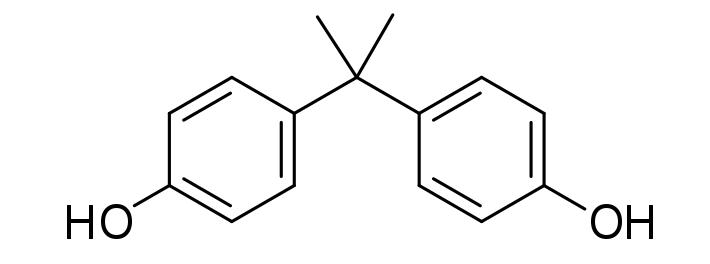
You've seen the label and you've probably heard a thing or two about bisphenol A (BPA). It's made by condensing two equivalents of phenol (the "bisphenol") with one of acetone (the "A"), and its mass production took off in the 1950s.

Despite BPA's recognition as an artificial estrogen in the 1930s, the molecule's debatable health consequences have been outweighed by its ability to make useful polycarbonates, which take about two-thirds of it, and epoxy resins, which take most of the rest. It is now known that trace amounts of BPA can leach from the materials it is turned into when they are exposed to hard use (scratching) or high temperatures (your microwave and dishwasher), and the EU banned it in food-contact materials starting in 2025.
In any case, the world now makes about 10,000 KTA of the molecule, and China alone has about 5,900 KTA of capacity. Elsewhere it's shrinking: Covestro plans to stop making it in Antwerp, and LG Chem is selling its Daesan, South Korea plant to epoxy maker Kukdo.