Good morning. Today: GE's old lamp phosphor plant in Cleveland makes more rare-earth fluorides for magnets, Nouryon's MMAO plant in China slips a year, and WeylChem looks at melting more sulfur in Bilbao. See you next Friday!
| WTI Crude | $89.62/bbl | -2.3% |
| Brent Crude | $92.14/bbl | +0.3% |
| HH Nat Gas | $3.00/MMBtu | +14.1% |
| MB Propane | $1.06/gal | +0.1% |
| 3:2:1 Crack | $34.92/bbl | -5.6% |
GE's old lamp chemists go after magnets
Current Chemicals is getting more money from its Dutch owner, Momentum Global Ventures, to make more neodymium fluoride, dysprosium fluoride and other rare-earth fluorides, the salts that get reduced to metal for the magnets in motors, wind turbines and missiles.
A little history:
It makes them at GE's old Ivanhoe Road plant in Cleveland, which spun out of Current Lighting in February. For decades the plant made the phosphors for GE's lamps: the powders inside a fluorescent tube that turn the mercury's UV light into visible light, many of them built on rare earths like europium and terbium. By 2020 it was already making rare-earth oxides and fluorides alongside them, so the move to magnets isn't much of a stretch.
Why does it matter now?
Most rare-earth fluoride is made in China, and from January 1, 2027, the Pentagon can't buy neodymium magnets with any step done there, mining and refining included. Current Chemicals is one of the few US companies already making the fluorides. The usual way is to react the oxide with hydrofluoric acid. Up the road in Euclid, REalloys says it has a way to skip the acid, so far only in the lab.
More solar means more MMAO
Nouryon now plans to start making modified methylaluminoxane (MMAO) at its site in Jiaxing, China, in the first half of 2028.
Feeling déjà vu?
We mentioned this plan last October, when Nouryon said MMAO would start at Jiaxing in 2027, so it looks like they're about a year behind. They haven't said why.
Why MMAO, and why China?
It's driven by solar. The film that seals the cells to the glass in a panel has mostly been EVA, but EVA forms acid and resists potential-induced degradation poorly, which matters more in the newer, more efficient panel designs. Polyolefin elastomers (POE) insulate better and let less water vapor through, so they've been taking share, and China has been building its own: its POE imports fell 20% to 728 KTA in 2025 and another 39% through August.
Where does MMAO come in?
Making POE can take it twice. First for the comonomer: MMAO is the cocatalyst for the ethylene tri- and tetramerization that makes 1-hexene and 1-octene. Then for the polymer: the single-site catalysts that put those alpha-olefins into polyethylene chains need an activator, usually an aluminoxane like methylaluminoxane (MAO), to methylate the metal and pull off a ligand. MMAO is a modified MAO that, unlike MAO, can be sold in non-aromatic solvents like heptane instead of toluene.
Melting more sulfur in Bilbao
Spanish sulfuric acid maker WeylChem Bilbao got its shareholder's approval for a feasibility study into "substantially" expanding the sulfur-melting unit at its plant in the Port of Bilbao.
What's the plant?
Befesa built it in 2012 as a sulfur burner: it burns 120 KTA of refinery sulfur to sulfur dioxide, oxidizes that to sulfur trioxide and absorbs it into 350 KTA of sulfuric acid and oleum, selling the spare heat as power. Ineos bought it in 2015 and sold it to ICIG in 2021, which folded it into WeylChem. Most of its sulfur arrives solid, by truck, and is melted on site.
Why melt more?
Most of Europe's molten sulfur goes to burners like this one, making acid for things like caprolactam and titanium dioxide. Refineries, its main source, are running less and closing, and crude got sweeter once Russian barrels were banned. Contract prices rose by about half in 2024, and some Benelux acid plants shut for lack of sulfur. Europe has little capacity to remelt solid sulfur, and Argus sees none new for at least two years. WeylChem Bilbao already sells molten sulfur across Europe, so a bigger melter could let it take in more cheap solid sulfur and sell it on as liquid to acid plants that can't melt their own.
The Reboiler:
- Europe's lithium mines are struggling to get off the ground.
- BASF doubled its Louisiana MDI capacity to 600 KTA.
- SNF is buying BASF's mining chemicals business.
- Mitsubishi Gas Chemical is expanding its chip packaging laminate production in Thailand.
- Nextchem is buying Metso's sulfuric acid technology business.
- Henkel's ATP opened a $70M adhesive tape plant in South Carolina.
- Ronbay is spending $540M on sodium-ion cathode capacity in China.
- Denka is spinning off its styrene business.
- Thyssenkrupp Nucera started up a 220 KTA chlor-alkali plant in India.
- PeroCycle will test a CO₂-to-carbon monoxide reactor in England.
- dsm-firmenich is ramping up a hydrogenated rosin resin unit in France.
- Evonik Oxeno put AI process models into live operation.
- Mitsui Chemicals agreed to buy JSR, which we covered last week.
- The DOE restored Eastman's $375M recycling grant, which we covered last year.
- Aether Industries grew quarterly profit 26%.
- Tsinghua chemists turned old wind turbine blades into a resin additive.
- NexPoint is closing its Alabama polycarbonate plant.
- BlueAlp won up to $24M in EU grants for a Dutch pyrolysis plant.
- Alta Performance Materials is buying BASF's polyester resins business in Chile.
- CVR Energy is buying two Marathon refineries for $4.2B.
- Afyren and Minasolve teamed up on biobased fragrance molecules.
- REalloys signed a deal to refine heavy rare earths at a US Army depot.
MOTD: methylene diphenyl diisocyanate
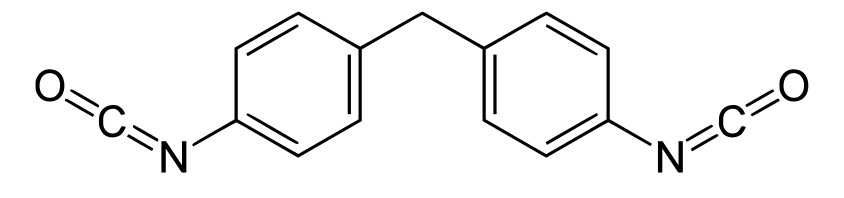
This mouthful of a molecule is commonly referred to as MDI, and it's one of the most popular diisocyanates on the market. MDI has only been around since the middle of the 20th century, but the world was already making more than 7,500 KTA of the stuff back in 2017.
MDI is made by reacting aniline with formaldehyde to get methylenedianiline, then reacting that with phosgene to turn its amines into isocyanates. Pretty much all of it is used to produce polyurethanes, a class of polymers formed by reacting an isocyanate with a polyol, most of all the rigid foam that insulates fridges and buildings. Besides the countless applications for polyurethanes, MDI also finds itself as a binder in composite wood products like oriented strand board.
The main producers of this good stuff are Wanhua, the world's largest, BASF, Covestro, Huntsman and Dow, and about half of it is made in China. This week BASF doubled its MDI plant in Geismar, Louisiana, to about 600 KTA.